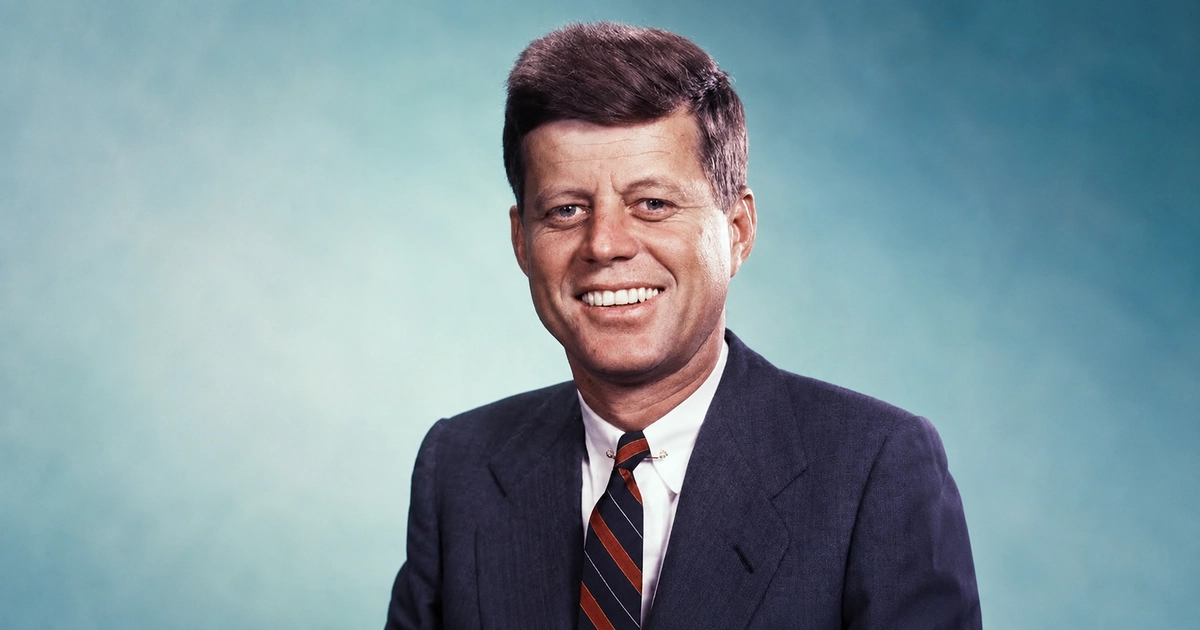
John F Kennedy height was 6 feet 1 inch (about 185 cm), according to the John F. Kennedy Presidential Library. But his physical stature is only one small part of a much larger story. John Fitzgerald Kennedy, widely known as JFK, was a World War II Navy officer, author, U.S. senator, and the 35th president of the United States.
Born on May 29, 1917, in Brookline, Massachusetts, Kennedy rose from a prominent political family to the White House at age 43. His presidency lasted less than three years, yet it included some of the most important events of the Cold War, including the Cuban Missile Crisis, the Bay of Pigs invasion, the expansion of the U.S. space program, and a major shift toward stronger federal civil rights action.
For readers searching for John F Kennedy height, wife, siblings, books, birthday, net worth, family, presidency, and assassination, this guide brings those facts together in one clear and detailed biography.
Table of Contents
John F. Kennedy Quick Facts
| Fact | Details |
|---|---|
| Full name | John Fitzgerald Kennedy |
| Known as | JFK, Jack |
| Born | May 29, 1917 |
| Birthplace | Brookline, Massachusetts, United States |
| Died | November 22, 1963 |
| Age at death | 46 |
| John F Kennedy height | 6 ft 1 in (about 185 cm) |
| Political party | Democratic Party |
| Presidency | 35th President of the United States |
| Term in office | January 20, 1961 – November 22, 1963 |
| Wife | Jacqueline Lee Bouvier Kennedy |
| Children | Four, two of whom survived infancy |
| Parents | Joseph P. Kennedy Sr. and Rose Fitzgerald Kennedy |
| Siblings | Eight |
| College | Harvard University |
| Military branch | U.S. Navy |
| Best-known book | Profiles in Courage |
The JFK Presidential Library records Kennedy’s birth at 83 Beals Street in Brookline, his Harvard years, and John F Kennedy height as 6 feet 1 inch.
Where Was John F. Kennedy Born?
John F. Kennedy was born in Brookline, Massachusetts, on May 29, 1917.
His birthplace was the Kennedy family home at 83 Beals Street. He was the second of nine children born to Joseph P. Kennedy Sr. and Rose Fitzgerald Kennedy. His maternal grandfather, John Francis Fitzgerald, was a former mayor of Boston, and Kennedy was named John Fitzgerald Kennedy in his honor.
Family and friends soon began calling him Jack. He grew up in a wealthy Irish-American Catholic family at a time when anti-Catholic prejudice still existed in American society and politics.
The Kennedy children were raised in a competitive household. Their father placed a strong emphasis on ambition, achievement, and success, while their mother carefully recorded details about the children’s lives and health.
Growing up with eight siblings also exposed Kennedy to constant competition, debate, sports, and family discussions about public affairs—experiences that helped shape his personality long before he entered politics.
“Readers interested in other U.S. presidents can also explore our profile of Barack Obama.”
Early Life and Education
Kennedy’s childhood was financially comfortable, but his health was often poor.
The JFK Presidential Library records that he suffered from several childhood illnesses. Before he turned three, he became seriously ill with scarlet fever and required hospital treatment. Health problems continued to affect him throughout much of his life.
Kennedy later attended Choate, a private boarding school in Connecticut. He enjoyed history, English, reading, and current affairs and was known for following newspapers even as a young student.
He entered Harvard University in 1936.
While at Harvard, Kennedy became increasingly interested in European politics and international relations. His father, Joseph P. Kennedy Sr., was serving as U.S. ambassador to the United Kingdom during part of this period, while Europe was moving toward World War II.
Kennedy’s senior thesis examined why Great Britain had been poorly prepared for war with Germany. The thesis was later revised and published as his first book, Why England Slept.
He graduated from Harvard in June 1940, concentrating in government.
Although John F Kennedy height later became a frequently searched physical detail, his education is more important for understanding the interest in government and foreign affairs that shaped his future career.
Explore another American political profile in our Abigail Spanberger net worth article, including her family, religion and public-service career.
John F. Kennedy Birthday
John F. Kennedy’s birthday was May 29, 1917.
He was born in Brookline, Massachusetts, and lived to the age of 46. The JFK Presidential Library lists his birth date as May 29, 1917.
Kennedy’s birthday is also associated with events honoring his political legacy. The John F. Kennedy Profile in Courage Award, inspired by his Pulitzer Prize-winning book, is traditionally presented around the period of his May birthday.
His birth date also helps explain one of the most famous facts about his presidency: he was only 43 years old when he entered the White House.
John F Kennedy Height
John F Kennedy height was 6 feet 1 inch, or approximately 185 cm.
This figure does not come from an unofficial celebrity-estimate website. The John F. Kennedy Presidential Library and Museum lists his height as 6’1″ in its Fast Facts collection.
In centimeters, John F Kennedy height was approximately 185 cm. In meters, that equals about 1.85 m.
Kennedy was therefore a relatively tall man, particularly when compared with the average American male of his generation. His height, slim build, carefully tailored clothing, and confident public presence contributed to the youthful image associated with his presidency.
However, John F Kennedy height can create a misleading impression of perfect physical health.
Kennedy suffered from significant health problems and chronic back pain. His back caused serious problems during his younger years and continued troubling him through adulthood. He underwent major medical treatment and surgeries during his political career.
So while John F Kennedy height contributed to a commanding public appearance, the private reality of his health was considerably more complicated.
John F. Kennedy’s Military Service and PT-109
After college, Kennedy joined the United States Navy during World War II.
He eventually served in the South Pacific and became commander of PT-109, a motor torpedo boat.
On the night of August 1–2, 1943, a Japanese destroyer struck PT-109 and split the boat apart. Two members of Kennedy’s crew were killed.
Despite injuring his already-troubled back, Kennedy helped organize the survival and rescue of the remaining crew.
The U.S. Naval History and Heritage Command records that Kennedy showed extraordinary leadership during the ordeal. He helped get injured crew members to safety and spent hours swimming during the effort to find assistance.
Kennedy later received the Navy and Marine Corps Medal for his conduct and a Purple Heart for injuries sustained during the incident.
The PT-109 story became an important part of Kennedy’s public reputation. It demonstrated courage and leadership before his political career reached the national stage.
Political Career Before the Presidency
After World War II, Kennedy entered politics.
In 1946, he successfully ran for the U.S. House of Representatives from Massachusetts.
Kennedy served three terms in the House before running for the U.S. Senate in 1952. He won and became increasingly prominent within the Democratic Party.
His health problems did not disappear during these years. He underwent serious back operations and spent periods recovering from surgery.
During one period of recovery, Kennedy worked on Profiles in Courage, the book that would later win a Pulitzer Prize.
By the late 1950s, his national political profile had grown considerably.
In 1960, Kennedy won the Democratic presidential nomination and chose Texas Senator Lyndon B. Johnson as his vice-presidential running mate.
He faced Republican Vice President Richard Nixon in the general election.
The 1960 presidential campaign also included a historic series of televised debates. Kennedy ultimately won a very close election and prepared to enter the White House at just 43 years old.
How Old Was John F. Kennedy When He Became President?
John F. Kennedy was 43 years old when he became president of the United States on January 20, 1961.
He remains the youngest person ever elected president.
Theodore Roosevelt was younger when he became president in 1901, but Roosevelt entered office following President William McKinley’s assassination rather than winning election to the presidency at that age.
Kennedy’s relatively young age became part of the image of a new political generation entering American leadership.
His youth, public speaking style, family image, and John F Kennedy height all contributed to the confident visual presence closely associated with his administration.
Kennedy was also the first Roman Catholic elected president of the United States, another historically significant aspect of his 1960 victory.
John F. Kennedy’s Presidency
John F. Kennedy served as president from January 20, 1961, until November 22, 1963.
Although he spent less than three years in office, his administration faced several major foreign-policy crises and important domestic challenges.
Bay of Pigs
One of Kennedy’s earliest major setbacks came in April 1961.
A U.S.-backed force of Cuban exiles attempted to invade Cuba and overthrow Fidel Castro’s government. The operation failed at the Bay of Pigs.
The failure became a major embarrassment for the new administration and raised questions about U.S. planning and intelligence.
Kennedy publicly accepted responsibility for the failed operation, and the experience influenced how he approached later national-security decisions. JFK Library archival records document his public remarks about the Bay of Pigs shortly after the invasion.
Cuban Missile Crisis
The most dangerous international crisis of Kennedy’s presidency came in October 1962.
American reconnaissance discovered Soviet nuclear missile sites being constructed in Cuba, only about 90 miles from Florida.
Kennedy secretly consulted advisers before announcing a naval “quarantine” around Cuba and demanding the removal of the missiles.
For thirteen days, the United States and Soviet Union appeared dangerously close to nuclear conflict.
Soviet leader Nikita Khrushchev eventually agreed to dismantle and remove the offensive missiles from Cuba.
Kennedy’s handling of the Cuban Missile Crisis later became one of the most studied episodes of his presidency.
The Space Program
Kennedy strongly supported the American space program.
In 1961, he challenged the United States to achieve the goal of landing a man on the Moon before the end of the decade.
Kennedy did not live to see the mission completed.
On July 20, 1969, Apollo 11 astronauts Neil Armstrong and Buzz Aldrin became the first humans to walk on the Moon.
The achievement became closely connected with the ambitious national goal Kennedy had championed during his presidency. The JFK Library records his push for Project Apollo and increased U.S. commitment to space exploration.
Peace Corps
Another enduring initiative associated with Kennedy was the Peace Corps.
Created in 1961, the program gave Americans opportunities to volunteer in communities abroad in fields such as education, agriculture, health, and development.
The Peace Corps reflected Kennedy’s broader emphasis on public service and international engagement.
Civil Rights
Kennedy’s civil rights record developed significantly during his presidency.
Civil rights leaders initially criticized his administration for moving too cautiously on racial inequality and segregation.
By 1963, however, Kennedy had moved toward a stronger federal position.
On June 11, 1963, he delivered a nationally televised civil rights address following the integration crisis at the University of Alabama. He described racial equality as a fundamental moral and constitutional issue and called for stronger federal action.
Kennedy proposed major civil rights legislation but was assassinated before it became law.
President Lyndon B. Johnson later signed the Civil Rights Act of 1964.
Public images often emphasize Kennedy’s confident appearance behind a podium, but his presidency is better understood through the difficult decisions and policy changes made during these major events.
Was John F. Kennedy a Good President?
There is no completely objective yes-or-no answer. John F. Kennedy’s presidency included important achievements as well as serious failures and unresolved issues.
Supporters frequently point to his handling of the Cuban Missile Crisis, support for the space program, creation of the Peace Corps, ability to inspire public service, and stronger civil rights position during 1963.
His communication skills also helped him build a powerful connection with many Americans.
However, his record was not without major criticism.
The Bay of Pigs invasion was a serious failure, and historians continue to debate aspects of his Cold War policies and the increasing American involvement in Vietnam.
Civil rights activists also criticized Kennedy for moving too slowly during the earlier part of his presidency.
Another difficulty in judging Kennedy is that his term was suddenly cut short. He served for less than three years, meaning many of his policies never had time to fully develop.
A balanced assessment is therefore more useful than simply calling him a great or poor president. Kennedy demonstrated significant leadership during some crises while also making mistakes and leaving major questions unresolved.
Who Was John F. Kennedy’s Wife?
John F. Kennedy’s wife was Jacqueline Lee Bouvier Kennedy, commonly known as Jacqueline Kennedy or Jackie Kennedy.
John and Jacqueline married on September 12, 1953, at St. Mary’s Roman Catholic Church in Newport, Rhode Island.
According to the JFK Presidential Library, more than 800 guests attended their wedding.
Jacqueline Kennedy became one of the most recognizable first ladies in American history.
She had a strong interest in art, culture, literature, and historic preservation. As first lady, she undertook a major project to restore the historic character of the White House and its furnishings.
Her style and public presence also attracted worldwide attention.
Photographs of John and Jacqueline together helped define the public image of the Kennedy era. Searches for subjects such as John F Kennedy height and wife reflect the continuing public interest in the couple and their family life.
Their marriage lasted until Kennedy’s assassination in November 1963.
John F. Kennedy’s Children and Family
John and Jacqueline Kennedy had four children, although only two survived infancy.
Their first daughter was stillborn in 1956.
Their daughter Caroline Kennedy was born in 1957.
Their son John F. Kennedy Jr. was born in November 1960, shortly before his father entered the White House.
Their youngest child, Patrick Bouvier Kennedy, was born prematurely in August 1963 and died two days later.
The JFK Presidential Library records that Patrick and the couple’s stillborn daughter were later buried near their father at Arlington National Cemetery.
Caroline and John Jr. became familiar public figures during the Kennedy presidency.
Their presence in the White House contributed to the administration’s youthful family image, although Jacqueline Kennedy also attempted to protect her children from excessive public attention.
Behind that glamorous public image, the family experienced considerable personal grief, including the loss of two children.
Who Were John F. Kennedy’s Siblings?
John F. Kennedy had eight siblings. He was the second of nine children born to Joseph P. Kennedy Sr. and Rose Fitzgerald Kennedy.
| Sibling | Known for |
|---|---|
| Joseph P. Kennedy Jr. | Older brother; naval aviator killed during World War II |
| Rosemary Kennedy | Younger sister |
| Kathleen “Kick” Kennedy | Younger sister |
| Eunice Kennedy Shriver | Major force behind the Special Olympics |
| Patricia Kennedy Lawford | Younger sister |
| Robert F. Kennedy | U.S. attorney general and senator |
| Jean Kennedy Smith | U.S. diplomat |
| Edward “Ted” Kennedy | Long-serving U.S. senator |
The Kennedy family had an extraordinary influence on American politics and public life.
Robert F. Kennedy served as U.S. attorney general during his brother’s presidency and later became a senator from New York.
Edward Kennedy, commonly known as Ted Kennedy, spent decades in the U.S. Senate.
Eunice Kennedy Shriver became internationally known for her work supporting people with intellectual disabilities and her connection with the Special Olympics movement.
Understanding Kennedy’s siblings helps explain the larger family network that shaped American politics and public life for generations.
John F. Kennedy Books
John F. Kennedy published works dealing with politics, history, leadership, international affairs, and immigration.
Why England Slept
Why England Slept developed from Kennedy’s Harvard senior thesis.
It examined Britain’s failure to prepare adequately for the threat posed by Nazi Germany before World War II.
The book demonstrated Kennedy’s early interest in international politics years before he entered elected office.
Profiles in Courage
Kennedy’s most famous book is Profiles in Courage.
He worked on the book during his Senate years while recovering from serious back problems.
It tells the stories of U.S. senators who took positions that threatened their political careers because they believed those decisions were right.
The book received the Pulitzer Prize for Biography in 1957.
A Nation of Immigrants
Kennedy also wrote A Nation of Immigrants, a work exploring immigration and its role in American history.
The book reflected his interest in immigration policy and the contribution immigrant communities made to the development of the United States.
These books add an important dimension to Kennedy’s biography. A profile focused only on his presidency and family would miss his serious interest in history, public leadership, and writing.
What Was John F. Kennedy’s Net Worth?
There is no single authoritative and independently verified figure for John F. Kennedy’s personal net worth at the time of his death.
Kennedy was born into an extremely wealthy family.
His father, Joseph P. Kennedy Sr., became a successful businessman and investor, allowing the Kennedy children to grow up with significant financial advantages. The JFK Library describes the family as enjoying a very comfortable life as Joseph Kennedy built his business success.
Many websites publish exact estimates of JFK’s personal fortune, but those figures can blur the difference between his personal assets, family trusts, and the wider Kennedy family fortune.
For that reason, presenting an unsupported exact number as confirmed fact would be misleading.
The most reliable conclusion is that John F. Kennedy came from one of the wealthiest and most politically connected American families of his era, while his exact personal net worth at death is difficult to verify from authoritative records.
That distinction matters in trustworthy biography content, just as an official historical source is preferable when verifying a factual detail such as John F Kennedy height.
John F. Kennedy Assassination
John F. Kennedy was assassinated on November 22, 1963, in Dallas, Texas. He was 46 years old.
Kennedy was traveling through Dealey Plaza in a presidential motorcade when shots were fired at approximately 12:30 p.m. Central Time.
He was rushed to Parkland Memorial Hospital and pronounced dead at 1:00 p.m.
Police arrested Lee Harvey Oswald later that day.
Two days later, nightclub owner Jack Ruby shot and killed Oswald while Oswald was in police custody.
President Lyndon B. Johnson created the Warren Commission to investigate Kennedy’s assassination.
The commission concluded that Oswald fired the shots that killed President Kennedy and that he acted alone. It also reported that it found no evidence establishing that Oswald or Ruby participated in a conspiracy.
However, the story of the official investigations did not end there.
The U.S. House Select Committee on Assassinations, reporting in 1979, concluded that Kennedy was probably assassinated as a result of a conspiracy, although it could not identify another gunman or determine the extent of such a conspiracy.
Because these official investigations reached different conclusions on the conspiracy question, Kennedy’s assassination continues to generate historical research and public debate.
Claims about the assassination should therefore distinguish confirmed evidence, official findings, and unproven theories rather than presenting speculation as fact.
John F. Kennedy’s Legacy
John F. Kennedy’s presidency lasted 1,036 days, yet his image and political influence have endured for more than six decades.
He is remembered for leading the United States during the Cuban Missile Crisis, supporting the effort to reach the Moon, creating the Peace Corps, delivering influential speeches about public service, and moving toward stronger federal civil rights action in 1963.
Kennedy is also remembered as a president whose record remained unfinished.
Historians continue to debate how his policies might have developed had he lived, particularly on issues such as Vietnam and civil rights.
His political image was shaped by many visible qualities—youth, style, family, television presence, and John F Kennedy height—but his historical importance comes from the decisions he made during an unusually tense period of the Cold War.
Kennedy’s life contained striking contrasts: great wealth but chronic illness, political privilege but dangerous military service, major successes alongside serious failures, and an optimistic public image followed by a violent and sudden death.
Those contrasts help explain why John F. Kennedy remains one of the most studied and recognizable American presidents.
Frequently Asked Questions
How tall was John F. Kennedy?
John F Kennedy height was 6 feet 1 inch (about 185 cm), according to the John F. Kennedy Presidential Library.
What was John F Kennedy height in centimeters?
John F Kennedy height was approximately 185 cm, or 1.85 meters.
When was John F. Kennedy born?
John F. Kennedy was born on May 29, 1917, at 83 Beals Street in Brookline, Massachusetts.
How old was John F. Kennedy when he became president?
Kennedy was 43 years old when he took office on January 20, 1961. He remains the youngest person ever elected U.S. president.
Who was John F. Kennedy’s wife?
His wife was Jacqueline Lee Bouvier Kennedy. They married on September 12, 1953, in Newport, Rhode Island.
How many siblings did John F. Kennedy have?
Kennedy had eight siblings and was the second of nine Kennedy children.
Did John F. Kennedy have children?
Yes. John and Jacqueline Kennedy had four children. Caroline Kennedy and John F. Kennedy Jr. survived infancy, while an unnamed daughter was stillborn and Patrick Bouvier Kennedy died shortly after his premature birth.
What books did John F. Kennedy write?
His best-known works include Why England Slept, Profiles in Courage, and A Nation of Immigrants. Profiles in Courage received the Pulitzer Prize for Biography in 1957.
What was John F. Kennedy’s net worth?
There is no authoritative exact figure for Kennedy’s personal net worth at the time of his death. He came from the wealthy Kennedy family, but online estimates can mix personal wealth with family assets and trusts.
When was John F. Kennedy assassinated?
Kennedy was assassinated on November 22, 1963, in Dallas, Texas. He was 46 years old.
Was John F. Kennedy a good president?
Kennedy is praised for areas such as his Cuban Missile Crisis leadership, the space program, the Peace Corps, and his stronger civil rights position in 1963. His record also included major problems such as the Bay of Pigs failure and controversial Cold War policies. A balanced assessment recognizes both achievements and shortcomings.
Conclusion
John F. Kennedy’s story extends far beyond a single presidential term. He was a Harvard graduate, decorated World War II Navy officer, congressman, senator, author, husband, father, and president who faced some of the most dangerous political challenges of the Cold War.
For readers who arrive searching for John F Kennedy height, the verified answer is 6 feet 1 inch (about 185 cm). But the more important story is how Kennedy moved from a privileged but frequently unhealthy childhood to wartime service and ultimately the White House.
His presidency included both success and failure: the Cuban Missile Crisis and the Peace Corps, the drive to reach the Moon, stronger civil rights advocacy in 1963, and the disastrous Bay of Pigs invasion.
His assassination at only 46 left unanswered questions about what a longer Kennedy presidency might have meant for the United States and the wider world.
More than six decades later, interest in John F Kennedy height, family, books, presidency, and assassination continues because JFK remains a complex, influential, and deeply studied figure in American political history.